Follow one worked path
Start with a free lesson
Start with the free ChatGPT Is Not an Agent lesson. Follow how a request becomes a tool action and then an observation.
Who This Course Is ForYou can trace Thought → Action → Observation and explain what the tool changed or returned.
Continue in the course player
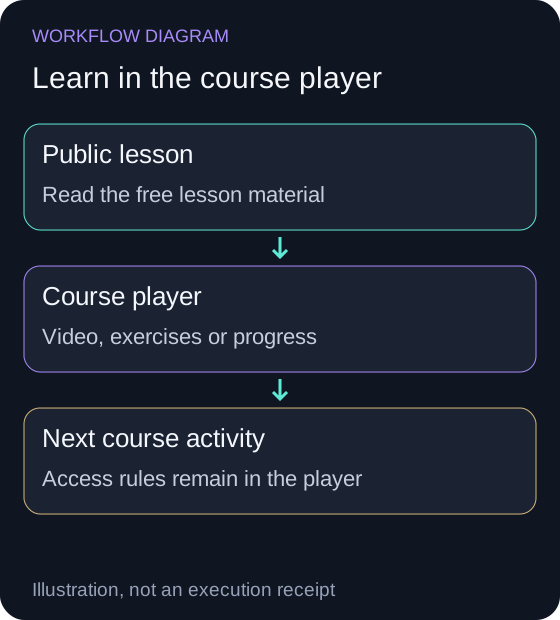
Open the player for video, activities and saved progress. Sign in when the course requires it.
Open the courseThe player handles access and progress; visiting this public guide does not complete an activity.
Inspect the course entry outline
Run one complete action and observation
Show the table · 3 rows, 2 columns
| Question | Answer in the executed local fixture |
|---|---|
| What was requested? | calculate_exposure with position_value 8000 and portfolio_value 10000 |
| What did the tool return? | 80% position exposure |
| What ended the loop? | The second decision returned the final answer: Fixture exposure: 80.00% |
No matching rows. Clear the filter to see all records.
The public Python example requests a position-exposure calculation for $8,000 out of $10,000. Its next authored decision receives 80% and finishes. Running the downloadable local fixture produces the output below with two decisions and one tool call. This exercise demonstrates the loop without a model, account or network request.
curl --fail --output react-agent-loop-demo.py https://nexustrade.io/seo/developer-guides/react-agent-loop-demo.py
python3 react-agent-loop-demo.pyWhat you will learn
Explore the full course learning outcomes
Explain the difference between a bare language model, a chatbot, and an AI agent
Compare a language-only reply with the tool observation that the local loop uses before its final answer.
Describe the ReAct loop (Thought → Action → Observation) and why it makes agents agentic
Follow the exposure request, the 80% tool result and the second decision in the runnable example.
Design tool-calling workflows and understand why tools, function calling, and MCP servers are all the same core concept
Read an operation name and its exact input schema, then inspect the corresponding returned fields.
Use autonomy controls (whitelists, approvals) to safely run agents in production
Try the dispatcher failure cases: an unknown name, denied write permission and an invalid percentage.
Connect memory, scheduling, and subagents into a full autonomous workflow
Distinguish saved context, a timed launch and a delegated task by the artifact each produces.
Build traces and evaluators (including LLM judges) to measure agent quality
Read known duration, model-call counts and missing-cost fields in the downloaded trace reader.
Start with free lessons
Start with the published free lessons below to learn the tools and assumptions before choosing the full course.
Follow the curriculum
Inspect the complete course progression and access
Sign in to the course player for premium readings and answer explanations, and to save your progress. Learner responses stay private.
| Module | Description |
|---|---|
| Module 1: Welcome | See the course syllabus for this module’s lessons. |
| Module 2: What Is an AI Agent? | See the course syllabus for this module’s lessons. |
| Module 3: Orchestration and Autonomy | See the course syllabus for this module’s lessons. |
| Module 4: Memory | See the course syllabus for this module’s lessons. |
| Module 5: Evaluation and Observability | See the course syllabus for this module’s lessons. |
| Module 6: Capstone | See the course syllabus for this module’s lessons. |
No matching rows. Clear the filter to see all records.
Course questions
Do I need to know how to code to take this course?
No. You'll use Aurora, NexusTrade's built-in AI assistant, to get hands-on experience with every concept: tools, the ReAct loop, memory, and subagents. Everything is done through natural language. The goal is for you to understand the patterns so that when you see them in code later, they already make sense.
Is this a general AI agents course, or is it specific to trading?
It's a general course. Trading is the context because NexusTrade and Aurora are the hands-on platform, but the concepts (tools, orchestration, autonomy, memory, evaluation) apply to any AI agent you'd build in any domain.
How is this different from the Algorithmic Trading Fundamentals course?
The Algorithmic Trading course teaches you how to build and deploy trading strategies. This course teaches you how AI agents work, using NexusTrade as the lab. You can take either one first. If you're interested in AI more than trading, start here.
What tools do I need?
A NexusTrade account. That's it. The hands-on activities all run inside Aurora chat. The two optional reading links at the end of the Module 2 System Prompt exercise (MIT Sloan + Prompting Guide) are free web resources.
What if I get stuck or have questions?
Join our Discord at nexustrade.io/discord or email [email protected]. The course is designed so you can re-watch any video and re-read any section at your own pace.
No comments yet.