TL;DR
The five largest qualifying dividend growers returned 44.80% versus SPY's 33.99% from January 2, 2025 through October 7, 2026. Starting in 2014, the same rules returned 340.90% versus 419.23%. Each test starts with $10,000 and reinvests dividends; the strategy pays 0.1% stock transaction fees while the stored SPY baseline pays no candidate commissions. Inspect all three periods and actual rebalances before selecting a variant.
See the strategy in action
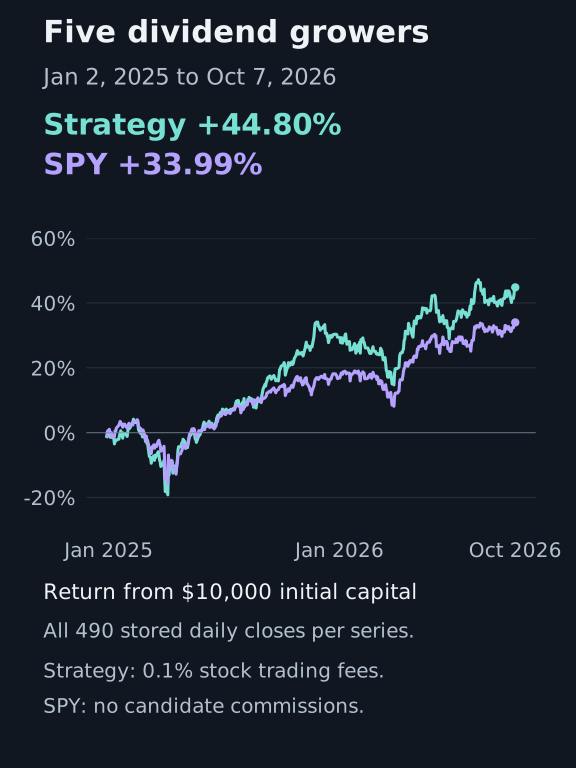
Five qualifying dividend growers, equal weights and $10,000 initial capital. The 2025 run returned 44.80% versus the stored SPY baseline's 33.99%, with 24.33% maximum drawdown. The longer 2014 run lagged SPY; inspect all three periods below.
1. Open the example
Choose Try in Aurora above. Review the request and the exact rules, then choose Start in Aurora.
2. Inspect the draft
Send the prepared request when you are ready. Aurora checks the strategy and shows its rules before saving or testing anything.
3. Run your own test
Ask Aurora to propose the dates, starting capital, fees and benchmark. Review those inputs before approving a backtest, then compare its completed chart and orders.
Compare all three completed backtests
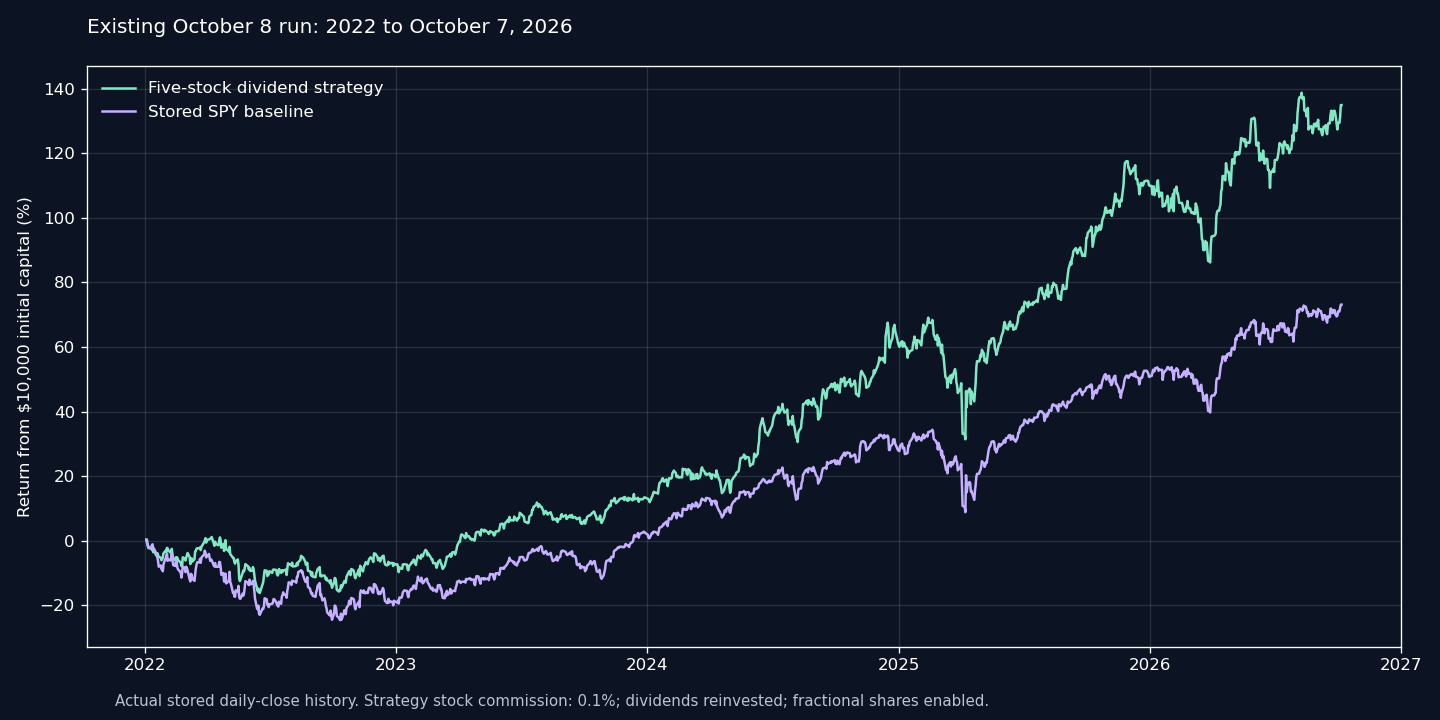
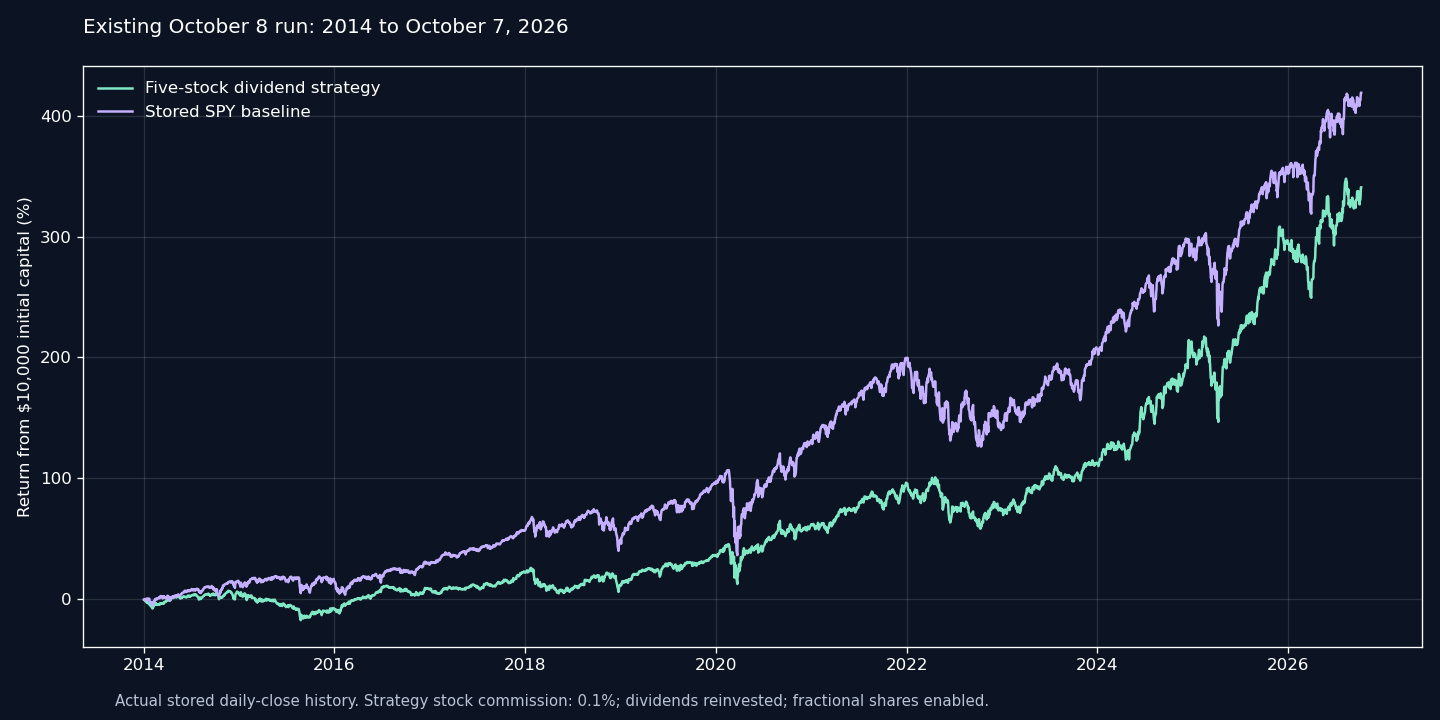
Independent $10,000 starts, all ending October 7, 2026; these periods overlap. Dividends reinvested. Candidate trades pay 0.1%; the stored SPY baseline has no candidate commissions.
Show the table · 3 rows, 6 columns
Scroll sideways to compare all columns. Select a heading to sort.
| 2025-01-02 | 44.80% | 33.99% | 24.33% | 49 | $24.15 |
| 2022-01-03 | 134.94% | 73.13% | 24.16% | 153 | $103.47 |
| 2014-01-02 | 340.90% | 419.23% | 24.16% | 422 | $331.98 |
No matching rows. Clear the filter to see all records.
This saved dividend portfolio has three completed historical periods. The same rules ran on October 8, 2026; each run starts with $10,000, reinvests dividends, permits fractional shares and charges 0.1% of stock transaction notional.
The strategy selects the five largest companies by market value among the SP500 universe that meet its ten-year consecutive dividend-increase test, gives each equal weight and targets 100% deployment. Rebalancing triggers when portfolio value equals initial value or at least 30 days have passed since a filled buy. Inspect the returned holdings and timestamps to see the actual rebalance cadence.
All three windows appear below. The 2014 window returned less than SPY. To explore the stock selection, follow the rebalance events and the companies returned by each universe query at its decision time.
The stored SPY baseline invests the full initial capital in fractional shares and reinvests dividends with no candidate commissions. The strategy pays 0.1% stock transaction fees and changes its holdings. Curves show recorded daily closes; the reported maximum drawdown uses the engine's observations. Compare fees, holdings and exposure alongside each return.
Review the saved rules before continuing
Inspect and download the exact strategy rules
These are the rules used in the completed backtests. NexusTrade validated this review configuration on October 10. The Aurora action above opens this exact configuration for review. Loading it starts no backtest and activates no trading.
{
  "initialValue": 10000,
  "supportsFractionalShares": true,
  "dividendPolicy": "reinvest",
  "strategies": [
    {
      "active": true,
      "condition": {
        "lhs": null,
        "rhs": null,
        "comparison": null,
        "type": "Or",
        "conditions": [
          {
            "lhs": {
              "compound": false,
              "targetAssets": [],
              "type": "PortfolioValue"
            },
            "rhs": {
              "compound": false,
              "targetAssets": [],
              "type": "InitialValue"
            },
            "comparison": "equal",
            "type": "Base"
          },
          {
            "lhs": {
              "compound": false,
              "targetAssets": [],
              "side": "Buy",
              "type": "DaysSinceOrder",
              "orderStatus": "Filled"
            },
            "rhs": {
              "compound": false,
              "targetAssets": [],
              "value": 30,
              "type": "Value"
            },
            "comparison": "greaterThanOrEqual",
            "type": "Base"
          }
        ]
      },
      "action": {
        "type": "DynamicRebalance",
        "universe": {
          "source": "SP500"
        },
        "pipeline": [
          {
            "type": "Filter",
            "condition": {
              "lhs": {
                "compound": true,
                "targetAssets": [],
                "type": "ConsecutiveIncrease",
                "maxLength": 1,
                "period": "Year",
                "lookback": 10,
                "indicators": [
                  {
                    "compound": false,
                    "targetAsset": {
                      "type": "",
                      "symbol": ""
                    },
                    "targetAssets": [],
                    "type": "LastDividend"
                  }
                ]
              },
              "rhs": {
                "compound": false,
                "targetAssets": [],
                "value": 10,
                "type": "Value"
              },
              "comparison": "greaterThanOrEqual",
              "type": "Base"
            }
          },
          {
            "type": "SelectTop",
            "metric": {
              "compound": false,
              "targetAsset": {
                "type": "",
                "symbol": ""
              },
              "targetAssets": [],
              "type": "Fundamental",
              "metric": "marketCap"
            },
            "limit": 5,
            "direction": "Highest"
          }
        ],
        "weightIndicator": {
          "compound": false,
          "targetAssets": [],
          "value": 1,
          "type": "Value"
        },
        "deploymentPercent": {
          "compound": false,
          "targetAssets": [],
          "value": 100,
          "type": "Value"
        }
      },
      "orderExecution": {
        "type": "Market"
      },
      "automaticOrderApproval": false
    }
  ],
  "name": "Five largest dividend growers",
  "cash": 10000,
  "buyingPower": 10000,
  "supportsCrypto": false,
  "alertsEnabled": false
}
No comments yet.