Moderna basically cured cancer, so I used Grok Bot to create a trading strategy on it. It’s DESTROYING the market.
Before deployment, the biotech book returned 62.97% on a sealed window that ended the day before Moderna’s readout; the semis book returned 44.43% on its own holdout. Those are historical tests, not measurements of the news thesis. After funding the account, I rejected the sector-gated design and rebuilt the $13,500 book around company-level signals. Four of five out-of-sample folds were profitable, and the worst OOS drawdown fell to 22.47%.
Austin Starks✦ Founder, NexusTrade✦ August 23, 2026 · updated August 26✦ 18 min read
LinkedIn is drowning in AI trading apps.
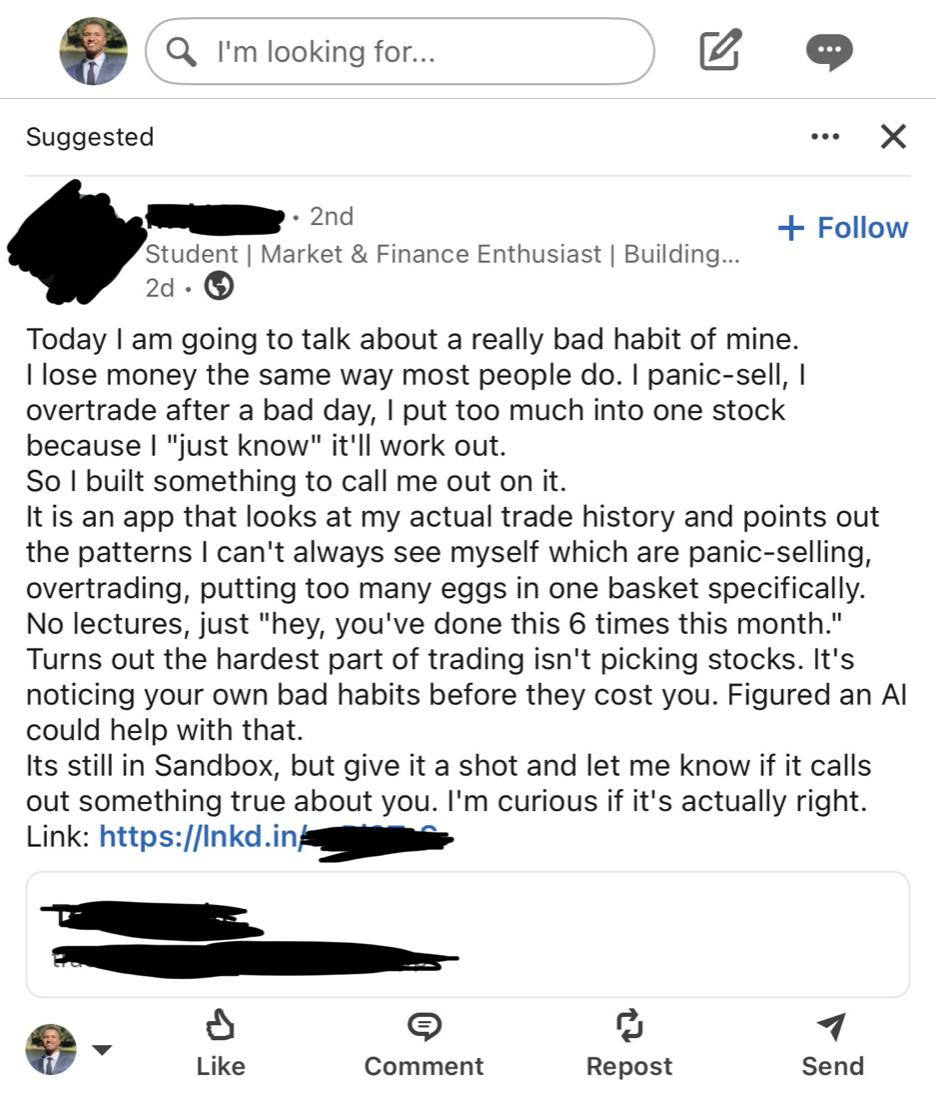
One from my feed: an app that audits trade history for panic-selling, overtrading and concentration. Still in sandbox.
This one audits your habits. Others launch backtests or generate signals. Some are useful. None of those demos answer the question I care about.
Would you give the AI real money and publish every fill?
Funded in February, first trade May 5, and up 26.58% in the 108 days since against SPY's 6.64%. A nineteen-name rotation of long-dated calls, built by describing it to an AI in plain English. I was writing about the same idea three years ago, using GPT-3. Every fill is public at that link.
$25,000 live account vs SPY · May 5 to August 21, 2026
Both indexed to 100 at the first fill. Portfolio series from the public shared-portfolio feed, SPY from the same price API. 108 days.
People call it dumb luck. So I am going to do it again, this time around the first positive Phase 3 result for a personalized mRNA cancer therapy.
The same platform Covid-19 accelerated. A new target: recurrence after melanoma surgery.
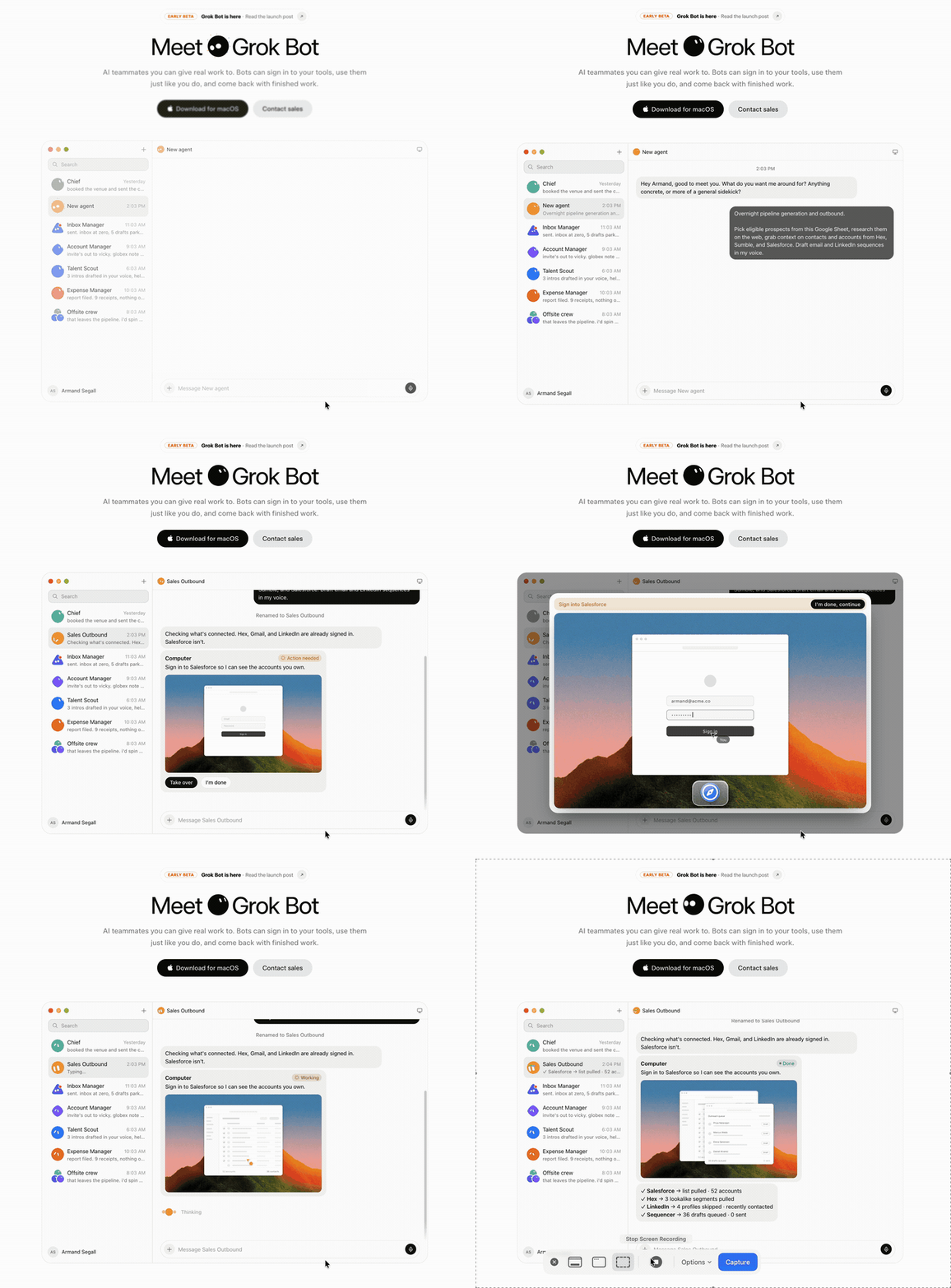
This time I am not going to hold the AI's hand. xAI shipped Grok Bot, an autonomous agent that gets its own cloud computer, signs into your services, and works for days without you. This is the test to see how good Grok Bot really is at developing trading strategies.
Grok Bot working on its own cloud computer: it spins up an agent, checks what is connected, and signs itself into Salesforce. Now point that at a brokerage.
I pointed it at the Public Portfolio Challenge runbook, the same discipline that built the account above. Then I gave it the thesis.
The edge is simple. Moderna's innovation proves AI is not a fad. Which means two things: biotech is about to have its most explosive rally ever, and AI is not going to stop.
That was the whole brief. A few hours later it came back.
Before I show you what it built, you need to understand what Moderna actually did.
What actually happened, and why it is an AI result
On August 19, Moderna and Merck announced that their personalized cancer vaccine passed a Phase 3 trial. Every patient had melanoma a surgeon had already removed and was at high risk of it returning. Both arms got Keytruda; one arm also got a vaccine built from their own tumor. Did the cancer come back less often, and did it spread to distant organs less often? Yes to both. Nobody has released survival data, so we do not know yet whether people live longer. It is still the first Phase 3 win ever recorded for a personalized mRNA cancer therapy.
It is built one patient at a time. Sequence the tumor, compare it to healthy tissue, and you get hundreds of mutations unique to that person. Then the step that made me want to trade this: an AI model reads every one of them and keeps the 34 most likely to provoke an immune response. Everything on either side of that prediction is chemistry Moderna already knew how to do.
The hard part was never synthesizing the mRNA. It was choosing what to put in it, and an AI model did that. Biology just became a compute problem.
How a personalized cancer vaccine is built: tumor sequencing, AI ranking from hundreds of mutations down to 34 targets, one mRNA instruction, and the T cell that finds the tumor.
Which is exactly why I am still long AI
I know the prevailing wisdom on social media and in the mainstream media is that AI has run its course.
That is backwards, and Moderna is the proof.
An individualized neoantigen vaccine creates a fresh compute workload for every patient. Each dose requires tumor and healthy-tissue sequencing, variant calling, neoantigen ranking, and the scheduling of a bespoke manufacturing batch. Melanoma alone is roughly 100,000 new US cases a year, and intismeran trials are already running in lung, kidney and bladder.
That is the bridge to silicon: more personalized programs mean more recurring sequencing, model inference, storage and networking. It does not prove the revenue impact will be material to any chip company. That uncertainty is why semiconductors are a separate forward thesis and a separate book, rather than a result I smuggled into the Moderna readout.
Two theses, so I created two agents in Grok Bot.
Why it started as two portfolios
I started with one account per sector so I could measure each thesis separately. Moderna Trading Bot traded the neoantigen chain, and SemiConductor Trading traded compute. The final cash-account design combines both sleeves in one funded portfolio.
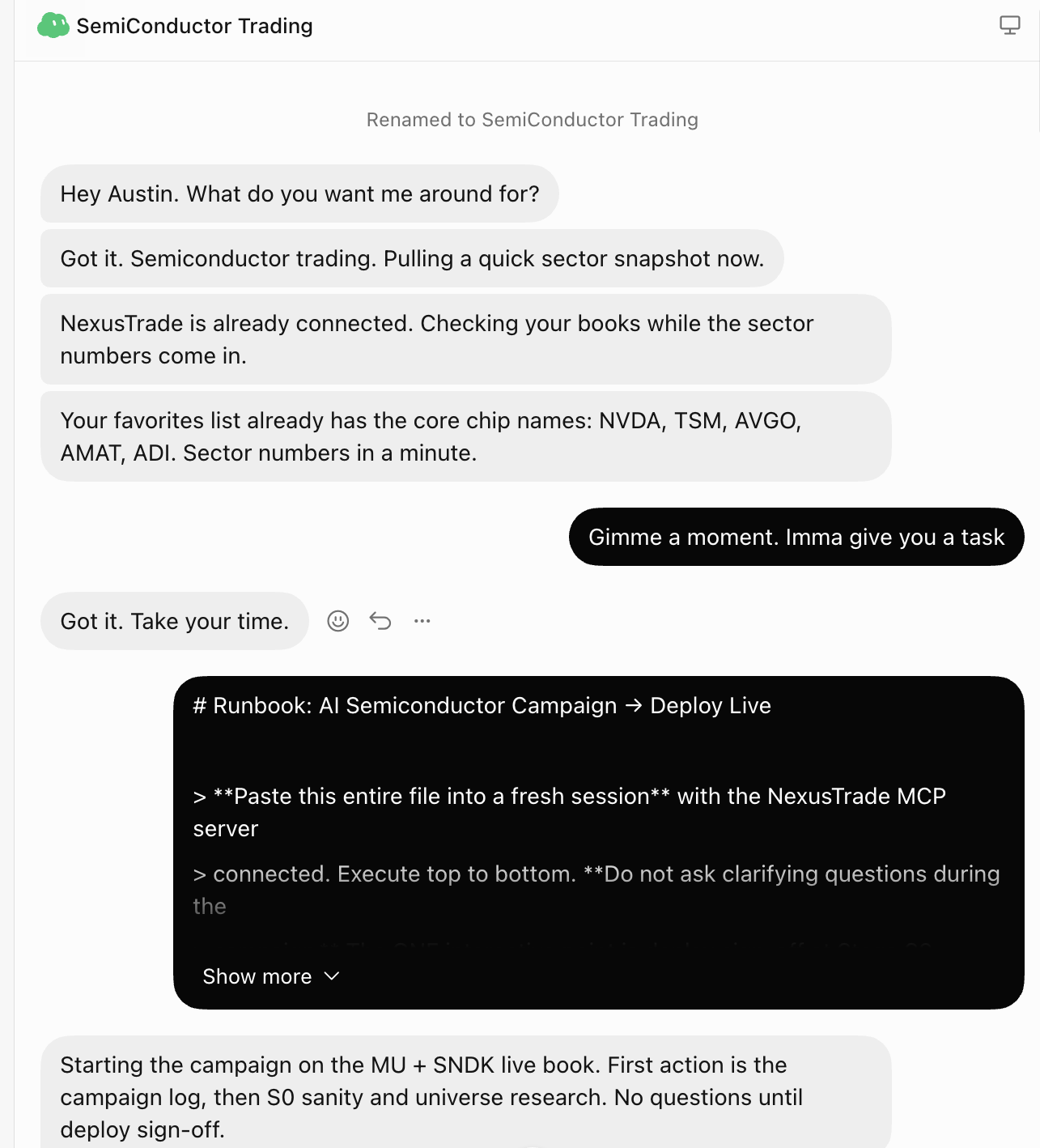
The second Grok Bot taking its runbook. I paste a spec, it works through it and only stops at deploy sign-off.
How I used Grok Bot to create my AI and biotech strategies
Grok Bot is only as good as the tools you hand it. Left alone with a browser it will read Reddit and guess. I gave mine three surfaces into one engine: MCP for the entire toolbox, the Python SDK for anything that has to run a hundred times, and a browser it barely touched.
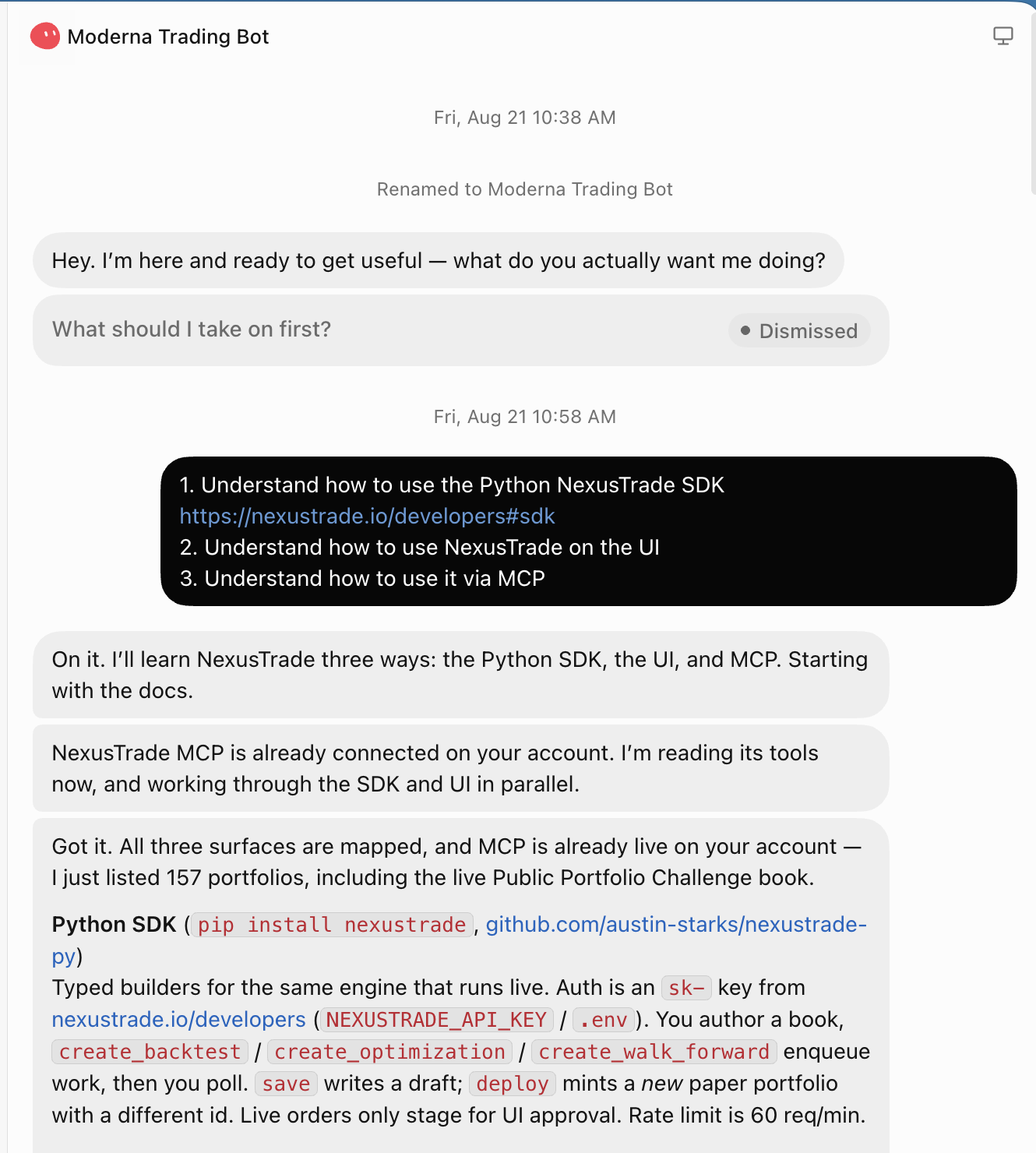
The Moderna Trading Bot on its first task. It found the MCP server already connected and listed 157 portfolios before I finished typing.
MCP is where all of the work happens. NexusTrade exposes 122 tools over it, and they are not only execution. Backtesting, walk-forward certification, options chains and deploys on one side. News search, SEC filings and web research on the other. Grok Bot never had to leave the connection to build either book. Connecting is one config block and an API key.
Live orders only ever stage. Nothing Grok Bot decides reaches the market without me clicking approve.
That includes the filings. Ten-Ks, 10-Qs, 8-Ks and the news wire, queried the same way as a backtest. It is why Personalis, which runs the tumor sequencing behind the Moderna program, is one of the twenty names the book trades. Tempus AI agreed to buy it on August 21 at a 28% premium, two days after the readout and three days after my measured window closed.
The Python SDK handles volume (pip install nexustrade). Studies enqueue and poll, so the Bot fires off a hundred backtests and collects them later.
The browser is pure redundancy. It can open NexusTrade and read the UI. Mine never needed to.
What I decided vs. what Grok Bot decided
I set the experiment: the theses, funded accounts, calendars, four-fold structure, lockbox rules and pass/fail gates. For biotech, I also wrote the universe criteria and supplied a long-dated-call skeleton to test. For semis, I left the universe and every trading mechanic open.
Grok Bot did the strategy work: it researched and froze the names, designed and swept the candidate mechanisms, killed the ones that missed a gate, chose the cross-fold robust settings, assembled the final books and staged them for my approval. I remained the only person allowed to approve a live order.
The rules it came back with
Here are the two original books, rule for rule. Not summaries, the literal conditions Grok Bot returned. The deployment architecture changed later, but these are the strategies that produced the sealed results.
The original books, rule for rule · every value read off the tested portfolios
BUY and SIZE are the pair that matters in both. A few hundred dollars of premium carries the exposure of several thousand dollars of stock, so each book runs a median of 15.44% deployed for biotech and 14.70% for compute and still moves like it is fully invested. That cuts both ways, and it is where the drawdowns come from.
I made Grok Bot prove it on data it was never allowed to see
Anyone can produce a backtest that looks incredible. Turn enough knobs against enough history and you will always find a setting that would have made a fortune, and then it dies the month you fund it. That is the whole problem with the genre.
So I made the tuning and the grading happen on different years. Grok Bot was allowed to adjust the rules on one stretch of market history, then graded on the year immediately after it, which it had never been shown. Then everything slid forward and repeated. Four times. Those four graded years are the four bars below, and no rule was ever tuned on the year it was graded on.
If you are quant-minded, you recognize this as walk-forward optimization.
Two rules on top of that. It had to deploy the settings that held up across all four graded years, not the settings that won the best one, because shipping your single best year is how you overfit while feeling rigorous. And the data stopped at April 14. No rule was tuned on a single day after that date, and I did not look at what happened next until the design was frozen.
The other place options backtests die is fills. Every fill is priced against real OPRA bid and ask, roughly 400 million quote rows per trading day. The engine does not fill at the midpoint. It fills at the midpoint plus half the spread against you, going in and coming out, and rejects contracts wider than the strategy's spread limit before the order is built. Minutes with no quote fall back to a measured spread table bucketed by moneyness and expiry, so a far out-of-the-money LEAP is charged about twice what an at-the-money one is.
Four graded years neither agent had seen · each book against its own benchmark
Eight graded years across the two books, every one positive, and seven of the eight beat their own benchmark. ARKG actually lost money in three of the four biotech years while the book made 26%, 25%, 56% and 21%. The semis book beat SMH in all four. No single lucky stretch dragging up an average, which is the failure mode that kills most strategies the day they go live.
Then I opened the lockbox
April 14 through August 18, 2026. Four months of real market history that neither agent had ever been allowed to see, replayed against the frozen rules with nothing left to tune.
The Moderna book returned 62.97%. Over those same four months the S&P returned 11.29%, and ARKG, the biotech ETF, returned 50.10%.
It did that with a median of 15.44% of the account actually spent, against benchmarks that are 96% invested every day by construction.
What that window does not contain is the news. The readout landed August 19, the day after the lockbox closed. So 62.97% does not measure the Moderna trade, it measures whether the rules survive four months they were never shown. I also froze the twenty names in August knowing how that stretch had gone, and that hindsight is in the name list. The rules got tested. The thesis is the forward bet, and it starts now.
The lockbox · April 14 to August 18, 2026 · daily equity, and how much cash was actually at work
The names were right, and that is most of the story. Those same twenty tickers held as ordinary stock, equal weight, no options and no ranking, returned 39.43% over the lockbox against the S&P's 11.29%. The sector carried it. That is the gold dashed line above.
ARKG caught the same wave, which is the honest part: a dedicated biotech ETF did 50.10% on those four months, so the sector was the tide, not my stock picking. The distance from there to 62.97% is step 5. It owned the move in long-dated calls instead of shares, and it did that on a sixth of the capital.
The semis book did the same thing on the silicon side, over its own window. Each campaign froze its holdout before it started, so the semis lockbox runs April 17 to August 23 rather than April 14 to August 18. +44.43% against SMH's +21.09%, and the same seven names held as ordinary stock returned 20.35%. So the book more than doubled both of them, and it did that at 14.70% deployed against their 96%. Twice the return on a seventh of the capital at risk.
The semis lockbox · April 17 to August 23, 2026 · S13 A against SMH
What it got right
Beat ARKG by 12.9 points and SPY by 51.7
Did it with 15.44% of the account spent, against 96% for both
All four graded years positive, worst +20.75%
Better return per unit of downside risk than SPY (Sortino 4.25 against 3.50)
17 of 20 names traded, so no single-name lottery
What it got wrong
ARKG earned its return more smoothly (Sortino 5.16 against 4.25)
Worst peak-to-trough fall was 24.88%, against ARKG's 13.48%
Universe was picked in August 2026, so hindsight is in it
Replayed on historical chains, not live fills
I did not trust the first live design, so I rebuilt it.
August 26 update: on August 24 I funded one $13,500 Public account with two long-call sleeves. Biotech waited on XBI. Semiconductors waited on SMH. The account bought one QGEN call, then the sector gates kept the rest of the book quiet.
I hated the explanation because it did not match the thesis. ANET is not SMH. MRNA is not XBI. Diagnostics, sequencing infrastructure, life-science tools, compute, networking and semiconductor equipment do not share one demand mechanism just because an ETF provider puts them in adjacent boxes.
So I reopened the entire design. Entry rules, exits, option structure, sizing, deployment and portfolio construction were all allowed to change. I did not give MRNA or ANET a special allocation. I did not require five profitable folds out of five. I required a candidate that was executable at the account's actual $13,500, interpretable at the order level and robust across genuinely separate market windows.
The design mistake
The first combined portfolio was still two independent sector queues. Lowering their exposure caps made drawdown worse because whichever queue evaluated first could crowd out the others. The final research candidate uses one central allocator. The thesis buckets explain why a company belongs. They do not own separate cash queues.
The final universe contains 26 companies across eight business mechanisms:
Therapy platforms MRNA MRK BNTX BMY Computational discovery RXRX SDGR Precision diagnostics ADPT GH NTRA VCYT Measurement infrastructure ILMN TWST QGEN TXG PACB Life-science tools TMO DHR A TECH AI compute NVDA AVGO MRVL Manufacturing and equipment TSM AMAT LRCX Networking ANET
Every company has to pass its own 100-day trend and 63-day momentum checks. One allocator ranks the eligible names by 126-day return and weights them by 63-day return divided by 63-day volatility. There is no XBI gate. There is no SMH gate. Every holding is a single long call, so the cash account never depends on spread approval or a short option leg.
OOS window
Return
Sortino
Max DD
Median deployed
Nov. 2022 to Jul. 2023
+42.87%
3.26
15.01%
28.30%
Jul. 2023 to Mar. 2024
+25.00%
1.99
15.33%
14.17%
Mar. 2024 to Dec. 2024
-2.22%
-0.31
21.64%
19.42%
Dec. 2024 to Aug. 2025
+9.95%
0.62
22.47%
22.76%
Aug. 2025 to Apr. 2026
+65.40%
5.61
8.09%
25.38%
The pass condition was never five profitable folds. The result was four of five, a +25.00% median OOS return, 1.99 median OOS Sortino and 22.47% worst OOS drawdown. The losing fold was -2.22%. It stayed in the table because deleting the inconvenient year would make this exercise pointless.
Full replay
+252.37%
Mar. 2022 to Apr. 2026
Maximum drawdown
29.79%
573 days underwater
Median deployed
30.53%
20 of 26 names traded
The full $13,500 event replay finished at $47,570.44 with a 2.02 Sortino and 496 option fills after default option fees. Marked option exposure reached 62.78% even though the entry gate was lower. That is not a contradiction: the gate blocks another buying cycle; it does not force-sell calls that appreciate. The strategy can still spend a year and a half underwater. That is the risk profile.
The separate-bucket version was not useless. It produced four profitable folds out of five and a 2.54 median Sortino. It lost the construction decision because worst OOS drawdown reached 33.43%. Cutting its aggregate gate from 48% to 40% or 32% made the worst drawdown worse, not better. The central allocator reduced it to 22.47%.
ANET was the best gross cash-flow contributor in the weak separate-bucket fold, at about +$1,867. It still was not affordable in the current executable snapshot: one audited long-dated contract cost about $2,225 against an $810 per-company budget. The strategy rejected it instead of silently making ANET a 16% bet.
The validated replacement is now live
On August 26 I preserved the rejected six-strategy, sector-gated implementation in a separate paper portfolio, then replaced the live Public account's strategy set with an exact copy of the validated 29-strategy object: one 26-company allocator, two global option exits and 26 company-specific exits. The brokerage account, its history and the existing QGEN December 2027 $45 call were preserved. Automatic approval remains off at both the portfolio and strategy level.
A current-book reconciliation resolved the account at $13,335.02. Its target was the same single QGEN contract already held. It produced zero orders, $0 estimated cost and no wash-sale flags. QGEN remains in the thesis universe, and none of its exit conditions fired, so the redesign did not force a sale or create a duplicate order.
Open the live account · replacement deployed August 26, 2026 · current-book reconciliation required no orders
The exact candidate, fold table, event audit, engine defects and deployment boundary are in the final Episode 11 redesign record. The earlier combined-book addendum stays public because it documents the design I rejected.
Concluding thoughts
I expected to write the post where the agent produces a beautiful backtest that falls apart the second you hold out a window. That is what the LinkedIn posts never show you, because they never hold one out.
Instead, Grok Bot produced two useful starting books and a pair of sealed historical results. Then the funded implementation exposed a design problem the headline results could not answer: how should one small cash account allocate across companies whose theses are related but not interchangeable?
The answer was not a biotech switch, a semiconductor switch or a privileged MRNA and ANET core. It was one allocator that lets each company qualify on its own evidence, then makes every candidate compete for the same scarce options budget.
The measurement still has limits. I selected the 26-company universe with August 2026 knowledge. The replay uses historical option chains rather than future live fills. The worst full-period drawdown was 29.79%, and the longest underwater stretch was 573 days. Four profitable folds out of five is evidence, not certainty.
Every campaign log, fold table and failed parameterization is in the Public Portfolio Challenge repo. The rejected sector-gated design stays in the history next to the selected one. A track record containing only winners is a marketing document.
The redesign is now the live strategy set. QGEN remains the only position, the deployment reconciliation required no orders and all future orders still require manual approval. Episode 12 is the forward test: whether this company-level allocator can turn a strong thesis into disciplined exposure without letting sector ETFs veto the names I actually chose.
Moderna's algorithm ranks 34 neoantigens out of hundreds and puts them in a syringe. I audited eight thesis buckets, 26 companies and 496 simulated option fills before deciding what the account should do next.
NexusTrade runs the same engine behind every number above, over MCP, a Python SDK, or the browser. Walk-forward certification, options backtesting on real chains, paper and live deploys. Free to start, no code required.

No comments yet.