The five that decided it
Four went to OpenAI. One went to Google.
Five harnesses ran. Every one of them is on the board. Open a row if you want the table it came from.
| Benchmark | Field | Winner | The margin |
|---|---|---|---|
| Planning | 16 models, 29 conversations | GPT 5.6 Luna | Within one standard error of the top score at $0.0012 a decision, the cheapest in the field |
| Execution | 23 models, 69 decisions x 3 | GPT 5.6 Luna | 89.2, and the only model to beat the old default on score, cost, latency and schema at once |
| Artifact grading | 23 labeled artifacts, map then reduce | GPT 5.6 Luna | 83.1% of defects found, grade stuck on 19 of 23 re-runs. MiniMax stays the fallback |
| Sandbox codegen | 5 models, one task, real Modal VMs | GPT 5.6 Luna | Top grade, fastest, cheapest — simultaneously. DeepSeek took 3x the wall clock and 2x the cost to never get there |
| Stock screening | 22 questions to DuckDB SQL | Gemini 3.6 Flash | Beat Luna by 29 points of average score. Google keeps this one |
Planning · 16 models · Luna is within one SE of the top score at 1/263rd of Opus
Planning: 16 models, 29 frozen production conversations
Router V5 reads a request and decides what to do: write a plan, dispatch to a catalog tool, ask a clarifying question, or continue an existing agent. I froze 29 real conversations, hand-labelled them, and replayed every model through the identical corpus.
| Model | Score | +/- SE | $ / decision | p50 |
|---|---|---|---|---|
| meta/muse-spark-1.1 | 0.759 | 0.079 | $0.0229 | 9.6s |
| openai/gpt-5.6-luna | 0.731 | 0.068 | $0.0012 | 8.6s |
| openai/gpt-5.6-luna-pro | 0.731 | 0.068 | $0.0076 | 21.9s |
| moonshotai/kimi-k3 | 0.731 | 0.068 | $0.0799 | 38.9s |
| x-ai/grok-4.5 | 0.724 | 0.065 | $0.0519 | 23.5s |
| deepseek/deepseek-v4-pro | 0.710 | 0.064 | $0.0142 | 27.2s |
| google/gemini-3.6-flash | 0.662 | 0.070 | $0.0387 | 8.5s |
| anthropic/claude-opus-5 | 0.662 | 0.074 | $0.3159 | 26.6s |
| openai/gpt-5.6-terra-pro | 0.634 | 0.073 | $0.0646 | 16.0s |
| google/gemini-3.1-flash-lite | 0.586 | 0.066 | $0.0031 | 1.8s |
| anthropic/claude-sonnet-5 | 0.579 | 0.071 | $0.1348 | 24.9s |
| z-ai/glm-5.2 | 0.515 | 0.079 | $0.0246 | 44.8s |
| deepseek/deepseek-v4-flash | 0.493 | 0.080 | $0.0032 | 12.4s |
| qwen/qwen3.8-max | 0.400 | 0.082 | $0.0421 | 168.7s |
Muse Spark posted the highest raw score in the field at 0.759, above Luna and above anything Anthropic or Google shipped. It's Meta's, where my twin brother Justin Starks is a senior software engineer.
Good news, Justin. That six-figure stock vest might be worth something one day.
It still isn't my default. 0.028 of score is not worth paying nineteen times more per decision, and I'd have told him the same thing.
Opus 5 costs 263 times what Luna costs and doesn't score better. They tie on 17 of the 29 fixtures and split 7 to 5 on the rest. A paired t-test puts that difference at t = +0.85, which is nothing.
Against Sonnet 5, Luna wins by +0.152 at t = +2.11. That one is real.
Ten of the sixteen models are dominated outright: something else beat them on cost and latency and score at the same time. Both Anthropic models are on that list.
Execution · 23 models · Luna is the only one that beat the old default on every axis
Execution: 23 models, 69 frozen decisions, 3 samples each
The planner writes the plan. The executor lives inside the ReAct loop and picks the next action, over and over, until the job is done. This is where an agent actually spends your money.
Luna is the only model of 23 that beat the previous default on every axis at once. It also outscores Muse Spark 1.2, the priciest model I tested, at one twenty-sixth of the cost.
| Model | Mean score | Schema valid | $ / 1k decisions | Prod p50 |
|---|---|---|---|---|
| openai/gpt-5.6-luna-pro | 91.7 | 100.0% | $25.05 | 9.9s |
| openai/gpt-5.6-luna | 89.2 | 99.0% | $1.67 | 5.6s |
| meta/muse-spark-1.2 | 86.1 | 99.5% | $44.23 | 7.2s |
| x-ai/grok-build-0.1 | 84.7 | 100.0% | $26.88 | 15.4s |
| google/gemini-3-flash-preview | 83.3 | 97.1% | $24.95 | 6.7s |
| z-ai/glm-5.2 | 82.4 | 98.1% | $25.37 | 15.7s |
| google/gemini-3.6-flash | 80.1 | 100.0% | $24.21 | 7.7s |
| deepseek/deepseek-v4-flash | 75.3 | 98.1% | $6.23 | 17.9s |
| mistralai/mistral-small-2603 | 73.0 | 97.6% | $1.00 | 6.3s |
| google/gemini-3.5-flash-lite | 72.3 | 99.0% | $7.17 | 2.0s |
| nvidia/nemotron-3-ultra-550b | 57.1 | 77.5% | $35.28 | n/a |
| poolside/laguna-xs-2.1 | 51.1 | 66.5% | $5.58 | 4.3s |
Nemotron 3 Ultra is a 550-billion parameter model that charges $35.28 per thousand decisions and could only hold my output contract 77.5% of the time. Parameter count bought nothing.
That's the migration I ran the same day.
Artifact grading · 23 fixtures · Luna wins the final judgment call on consistency
Artifact grading: same mapper findings, swap only the judge
Four cheap mappers propose defects. One reducer decides which ones are real and emits the letter grade. For this bake-off every model saw the exact same mapper findings, so the score measures judgment, not discovery.
| Model | Defects found | Same grade on re-run |
|---|---|---|
| openai/gpt-5.6-luna | 83.1% | 19 of 23 |
| tencent/hy3 | 83.1% | 18 of 23 |
| minimax/minimax-m3 | 82.5% | 16 of 23 |
Luna tied Hy3 on finding defects, then won on consistency. Re-running the same test, its grade stuck more often, and it raised fewer false alarms than MiniMax. MiniMax stays the fallback.
Sandbox codegen · 5 models, same task · Luna wins on grade, wall clock and cost simultaneously
Sandbox codegen: end to end on real Modal VMs
The sandbox operator writes code, runs it, reads its own artifacts, and keeps iterating through a remediation loop until the work clears review. Same prompt, same planner, same grader, real machines. Every model below ran the identical task: correlate Strait of Hormuz ship traffic against the next USO trading session.
| Model | Grade trajectory | Wall | Cost |
|---|---|---|---|
| openai/gpt-5.6-luna | D → B+ → D → B+ → D → B+ | 59m | $2.63 |
| z-ai/glm-5.2 | D → D → B+ → D → D → D | 91m | $2.72 |
| qwen/qwen3.7-flash | D → D → D | 124m | $2.85 |
| deepseek/deepseek-v4-flash | D → D → D → D → D → D | 181m | $5.17 |
| google/gemini-3.5-flash-lite | D, then failed out | 24m | — |
Luna is the only model that is best, fastest and cheapest at the same time. It reached the top grade in the field three separate times; GLM managed it once, and neither Qwen nor DeepSeek got there at all. DeepSeek is the mirror image of Luna: slowest, most expensive, never left the bottom band.
What the oscillation told me
This ran on an early build of the remediation loop, and the sawtooth in Luna's trajectory is the interesting part. Grades climb and fall back instead of ratcheting.
So I labelled every blocking finding in the corpus by hand, 221 of
them. Sixteen percent were arithmetic contradictions in the delivered
numbers.
Sixty percent were defects in code the agent wrote to check its own
work
— an audit script that assigned the same variable into both
delivered_stats and recomputed and then
hard-coded a match, acceptance fields written as a literal
True, a reconciliation reporting
"dedup_rows_removed": 2 against 18 rows in and 17 out.
Each pass fixed the finding it was handed and wrote a fresh self-check with a new hole in it, which is exactly what a sawtooth looks like. The fix isn't a better prompt or a bigger model. It's to compute those identities host-side, so the agent has no field to assert them in and nothing to get wrong. That work is underway; the table above is the before.
Stock screening · 22 questions · Gemini 3.6 Flash wins, by 29 points
Stock screening: Google wins this one outright
This is the direct descendant of EvaluateGPT. Twenty-two natural language questions, each turned into DuckDB SQL, executed against my real lake, and scored on whether the answer was actually correct.
| Model | Average score | Median | Success rate | Avg execution |
|---|---|---|---|---|
| google/gemini-3.6-flash | 0.841 | 1.00 | 86.4% | 26.6s |
| google/gemini-3-flash-preview | 0.791 | 1.00 | 81.8% | 18.9s |
| google/gemini-3.5-flash | 0.727 | 1.00 | 72.7% | 33.3s |
| google/gemini-3.5-flash-lite | 0.664 | 0.90 | 72.7% | 19.4s |
| openai/gpt-5-mini | 0.664 | 1.00 | 68.2% | 41.5s |
| openai/gpt-5.6-luna | 0.550 | 0.75 | 59.1% | 27.0s |
Gemini 3.6 Flash beat Luna by 29 points of average score and 27 points of success rate, on the exact task I built EvaluateGPT to measure. It's not close and I'm not going to soften it. Production runs the model that won.
The judges were biased too
Then I did the thing most benchmark posts skip. I took 827 rows that were already replayed and re-graded them with a judge from a completely different vendor, to find out how much of my result was my judge's taste.
| Model | Judged by luna-pro | Judged by gemini | Delta |
|---|---|---|---|
| gpt-5.6-luna | 89.2 | 92.4 | +3.2 |
| gemini-3-flash-preview | 83.3 | 94.1 | +10.8 |
| deepseek-v4-flash | 75.3 | 90.9 | +15.6 |
| muse-spark-1.2 | 86.1 | 91.8 | +5.7 |
Both judges prefer their own family. The Luna over DeepSeek gap collapses from +13.9 to +1.5 depending on who's grading.
Luna is the one model both judges agree about: 3.2 points of cross-judge disagreement against DeepSeek's 15.6. Output that's actually good scores the same no matter who grades it. Output that suits one grader's taste doesn't.
The deployment decision never rested on that score alone. Cost is provider billing. Latency is provider timestamps. Schema validity is a deterministic key check. On those three Luna beats the old default by 3.7x, 3.2x, and +0.9 points, and no judge touches any of them.
None of those tables proves that one model is universally smarter. Luna won four of the five harnesses, then separated itself on cost, latency, and schema discipline. Gemini won screening, where a user sits and waits and quality is visible in real time. Read together, the tables say the same thing: once several models clear the bar, engineering properties decide. That is a very different market from the one I bought Google calls for.
What I actually run
Luna runs almost everything now
Here is the production config, straight out of the constants file.
| Job | Model |
|---|---|
| Agent execution, every ReAct decision | GPT 5.6 Luna |
| Sandbox codegen | GPT 5.6 Luna |
| Portfolio generation | GPT 5.6 Luna |
| Artifact grading | GPT 5.6 Luna |
| Sweep gene authoring | GPT 5.6 Luna |
| Sandbox gateway calls | GPT 5.6 Luna |
| Standard chat | GPT 5.6 Luna |
| Stock screening | Gemini 3.6 Flash |
| Insight relevance | Gemini 3.6 Flash |
| Web search and news synthesis | Muse Spark 1.2 (experimental) |
| Social mention discovery | Grok 4.5 |
| Anthropic | nothing |
| DeepSeek | nothing |
Seven of the eleven jobs listed are Luna, including every one that runs inside the agent loop. Google keeps screening, where it beat Luna by 29 points, plus relevance ranking and the top rung of the authoring-retry ladder, the model a failed generation escalates to rather than retrying itself. Meta's Muse Spark took web search and news synthesis, on a factual search bakeoff in July, and is running experimentally on 1.2. Grok holds the one job that needs several simultaneous live searches, finding a person's social posts about a ticker.
Anthropic and DeepSeek run nothing. Not a batch job, not a fallback. Neither is a default anywhere. Agent models are fixed by the platform now, so users cannot select either one.
What this actually bought me
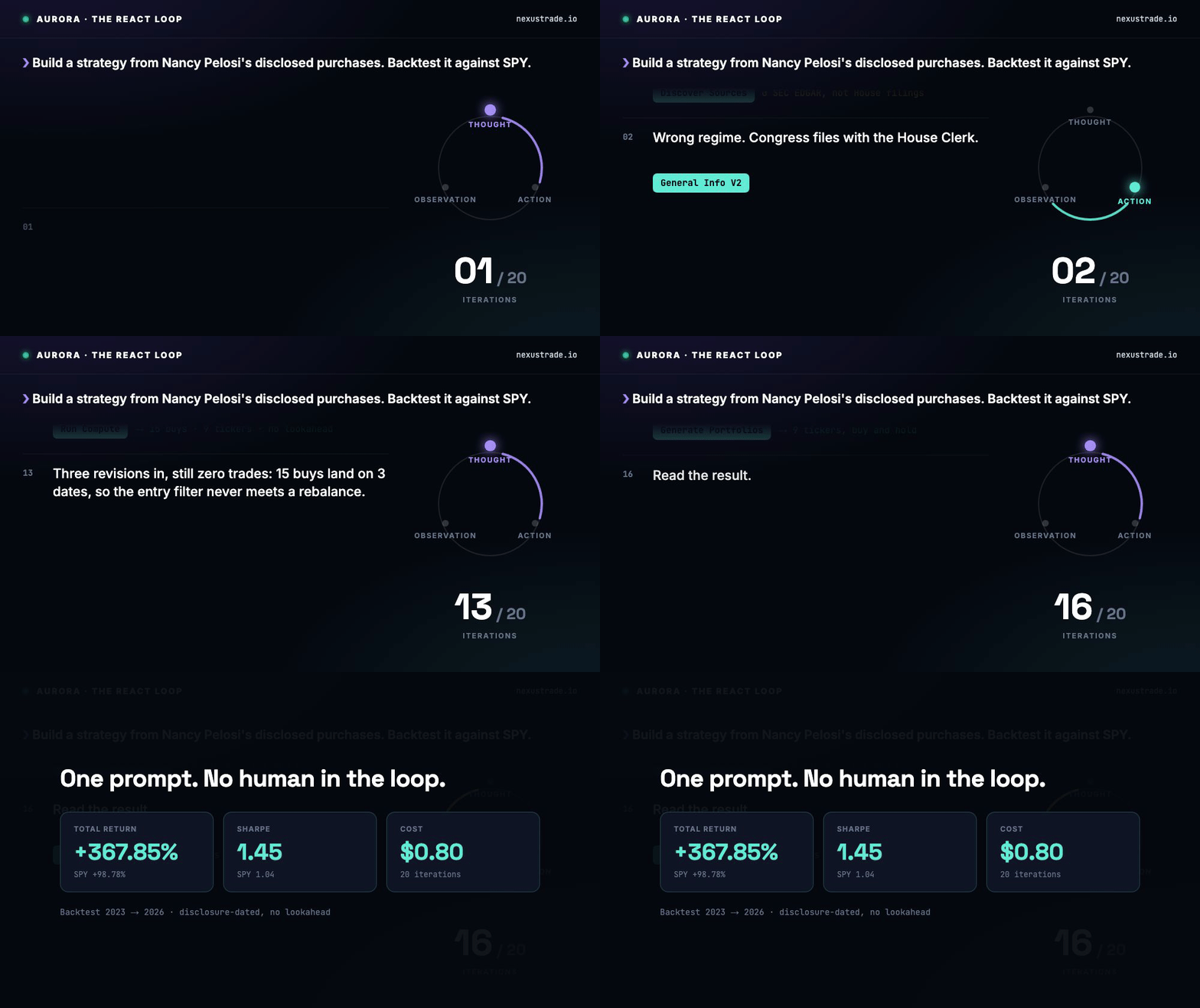
A year ago, turning 65 congressional filings into a tradeable signal meant paying frontier prices for every attempt, and the attempts fail a lot.
| Workload | Codegen | OCR | Compute | Grading | All in | Wall |
|---|---|---|---|---|---|---|
| pelosi (65 PDFs) | $0.91 | $0.83 | $0.0015 | $0.42 | $2.16 | 18 min |
| fundamentals OOS report | $0.44 | n/a | $0.0010 | $0.65 | $1.10 | n/a |
| hormuz research report | $0.50 | n/a | $0.0010 | $0.42 | $0.93 | 14 min |
| nvda average close | $0.16 | n/a | $0.0006 | $0.25 | $0.40 | 4 min |
| python hello world | $0.12 | n/a | $0.0006 | $0.23 | $0.35 | 3 min |
A full research report, written by an agent that rented a virtual machine, pulled data from my lake, ran statistics on it, and had its own output graded, for ninety-three cents.
The sandbox compute is 0.2% of that. The machine is never the cost. And grading is roughly fixed per cell while codegen swings sixteen-fold, so there's a floor around $0.35 on any call, two thirds of which is the grader on a trivial one.
The conclusion
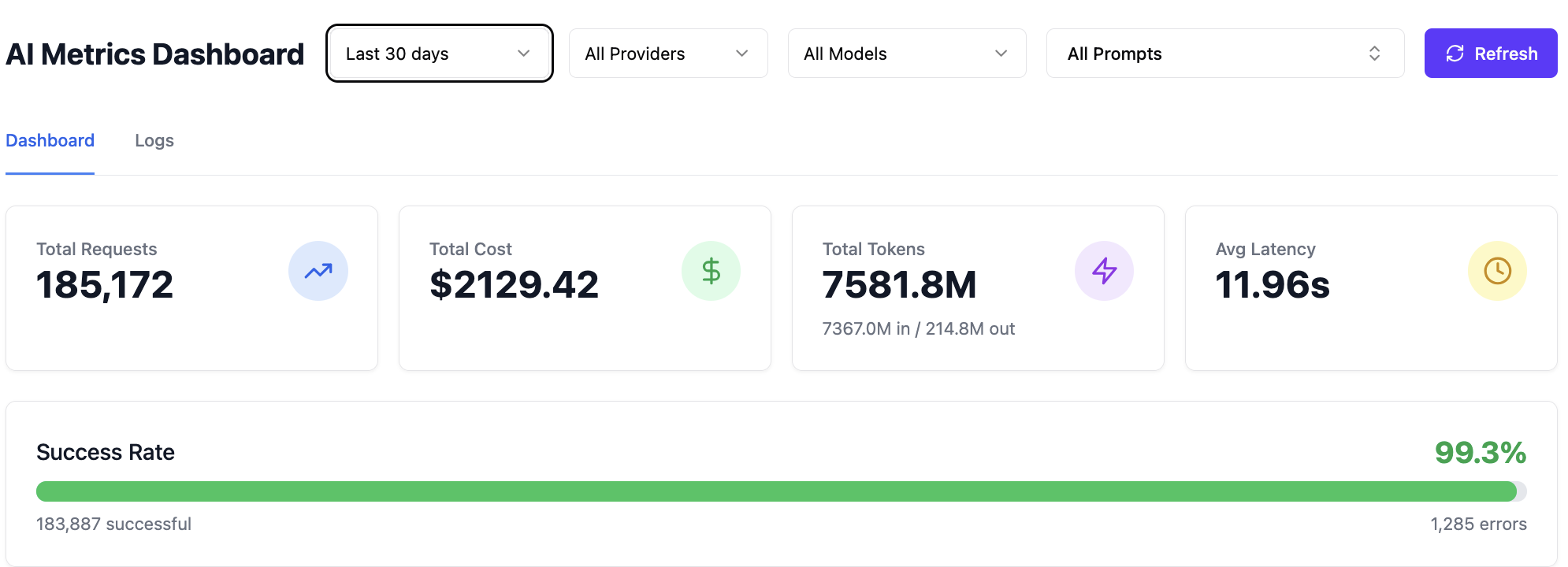
My LLM bill grew more than 5×. Google's projected share fell to 4%.
It used to be that Google was the only company that cared about people like me. Hobbyists and small businesses were being left out of the AI race because they couldn't afford to use the SOTA models for their tasks.
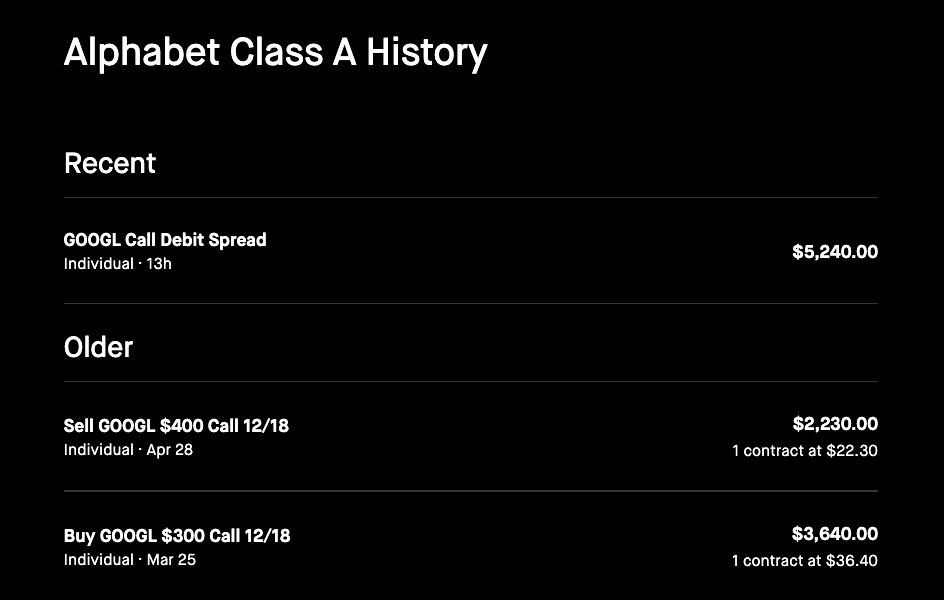
Google did not lose my dollars. Its billed revenue from me rose from about $342 to $841 as my workload grew more than fivefold. The signal is at the margin: of the $1,738 in new spend, Google captured about $500. The other 71% went elsewhere.
In the chart's prior-year comparison window, I spent $408 on inference and Google took 83.7% of it. They weren't a vendor, they were the supplier. Gemini 2.5 Flash and then 3 Flash were genuinely outstanding, and I built on them because nothing else was close on price per unit of intelligence. That was about $342 billed to Google.
In the August 8 vendor window, I spent $2,146. Google's share fell to 39.2%, but that was still about $841 billed to Google. Google more than doubled its dollars from me. It captured only 29 cents of each new dollar.
That's the whole story. Google kept the old work. It did not win most of the new work, on a platform where a year ago it was the only answer.
This is just the beginning
Most of the routing changes landed after the thirty-day window closed. In the last full day before the cutover, Google took 23.7% of my bill. In the first full day after it, Google's projected share fell to 4.0%. The 5% Anthropic slice in the chart is Claude traffic from before the Aug 6 cutover. At the new mix it is zero.
| Window | Calls | Total spend | Google share | |
|---|---|---|---|---|
| Before: Aug 5, 2 PM to Aug 6, 2 PM | 15,392 | $150.62 | $35.75 | 23.7% |
| After: Aug 7, 2 PM to Aug 8, 2 PM | 7,373 | $28.36 projected | $1.15 projected | 4.0% |
| Thirty-day run rate at the new mix | n/a | $851 | $34 | 4.0% |
This whole stack is available under your own brand.
The evaluation harnesses, the graded sandbox, the agent loop, and the data lake behind every number in this article are the same infrastructure I license to institutions. Execution rails into Tradier, Alpaca, TradeStation, and Public. Equities, options, futures, and crypto. Research agents that produce full audit trails and walk-forward backtests rather than opinions.
Three ways to deploy it: white-label under your brand, private deployment on your own infrastructure, or straight API integration. If you would rather not rebuild audit trails, position accounting, and broker connectivity from scratch, that part is already done.
If you'd rather read code than talk to me, the docs cover authentication, backtesting, agents and the full MCP tool surface. Both SDKs are public: nexustrade-py and nexustrade-ts, shipped to PyPI and npm.
The part where I might be wrong
I sold my Google calls. Alphabet is still a strong company. If someone asked me for safe, long-term investments that will be around for decades, I'd still answer Google. The growth case I was underwriting with leveraged calls is no longer the one I want to press.
| GOOGL | 2025-05-21, I published | 2026-08-06, migration day |
|---|---|---|
| Price | $168.56 | $357.75 |
| P/E, trailing | 18.46 | 17.92 |
| TTM revenue | $359.7B | $445.9B |
| Revenue growth, YoY | 13.1% | 20.1% |
| TTM net income | $111.0B | $244.2B |
| Net income growth, YoY | 34.7% | 111.3% |
The stock doubled and got cheaper on earnings. Growth accelerated on both lines. My original thesis was "priced like a dying consumer staple, expected to grow like a Y Combinator startup," and by these numbers that thesis is more true today than the day I wrote it.
I'm not claiming Alphabet is in trouble. Search, Cloud, TPUs and YouTube do not care which model wins my ReAct loop, and the fundamentals say whatever they're doing is working.
I sold leveraged calls after a 112% run, with a 322% return on committed capital. When I bought them, Google had a unique opportunity with Gemini. Google executed, and the stock more than doubled. But the model-cost moat I could observe directly was no longer unique: Google captured only 29 cents of each new inference dollar while other providers took the high-volume loop. I banked the gain. I did not give up on the company.
Running NexusTrade gives me a firsthand view of technology shifts before they become obvious in an earnings report. That founder's view has shaped positions across my long-term investing account, including the wins and misses below.
Google's $2,146 of inference spend is immaterial to Alphabet, but the change inside my stack is a real signal: a product advantage I could measure every day had weakened. I combine signals like that with valuation and fundamentals, and over time that process has produced real trading gains.
Google can keep growing. Just not monstrously. It is safe and sound in my long-term investing account.
What that actually buys me
I can now run state-of-the-art for less than last year's cheapest model cost me.
A year ago this platform screened stocks, ran backtests and deployed trading strategies. That was the entire product. Today the same agent rents a virtual machine, writes its own Python on it, reads the traceback when it breaks, grades its own work before handing it back, and runs walk-forward optimization on options chains.
That's a categorically harder job, and it costs less than screening and backtesting did twelve months ago.
Which is why the model stopped being the hard part. Luna reasoned better where it mattered: it raised the executor score from 75.3 to 89.2, and it won the artifact-grading slot too. But reasoning alone did not make it the production winner. It also emitted valid schema 99% of the time, returned in 5.6 seconds, and cost $1.67 per thousand decisions. Compared to Gemini 3 Flash, the difference is night and day.
Expensive, heavy models just don't have a place in my business on these jobs. Other workloads will keep their own winners, the same way screening kept Gemini.
Build a strategy with the deployment winner
Same agent, same data lake, same GPT 5.6 Luna measured in these five harnesses. Free to start, no card, no code.
Start free at nexustrade.io
No comments yet.