
Tuning — Carefully
Optimization makes your strategy better. Overfitting makes it useless.
Watch · What is Strategy Optimization? — And How to Avoid Overfitting
Once you have a working strategy, you may want to improve it by tweaking its parameters. If your strategy buys when RSI drops below 35, what happens if you use 30? What about 40? What SMA period maximizes Sharpe ratio? Optimization answers these questions automatically by trying hundreds of parameter combinations and returning the best one.
But there's a trap. A strategy perfectly optimized on 2020–2024 data is often completely useless in 2025. The optimization found parameters that fit the specific conditions of those years. It didn't find a universal edge.
Warning — The most dangerous mistake in optimization
If you optimize your strategy on 2020–2025 data and test it on 2020–2025 data, you will almost always get a great result. This is meaningless. Hold out a period the optimizer never saw. Test your strategy on that. If it falls apart on data it hasn't seen, the strategy is fragile, not good.
The rule of thumb: use 70% of your historical data for optimization, and test the result on the remaining 30% that the optimizer never touched. If the strategy holds up on both, you have something real. If it collapses on the hold-out period, keep iterating.
Part of the free course
Algorithmic Trading Fundamentals
6 modules · No code required · Connect Public.com for 3 months Premium free
Check Your Understanding
Two questions before you deploy.
Question 1
A strategy shows a Sharpe ratio of 0.3 and a max drawdown of -52%. Another shows a Sharpe of 1.4 and a max drawdown of -14%. The first strategy returned 38% and the second returned 22%. Which would you rather deploy, and why?
Question 2
You optimize your strategy on data from 2020–2025 and get a Sharpe of 2.1. You then test the optimized parameters on data from 2019 (which the optimizer never saw) and get a Sharpe of 0.4. What does this tell you?
What's Next
Your strategy has been tested. Now it's time to deploy it.
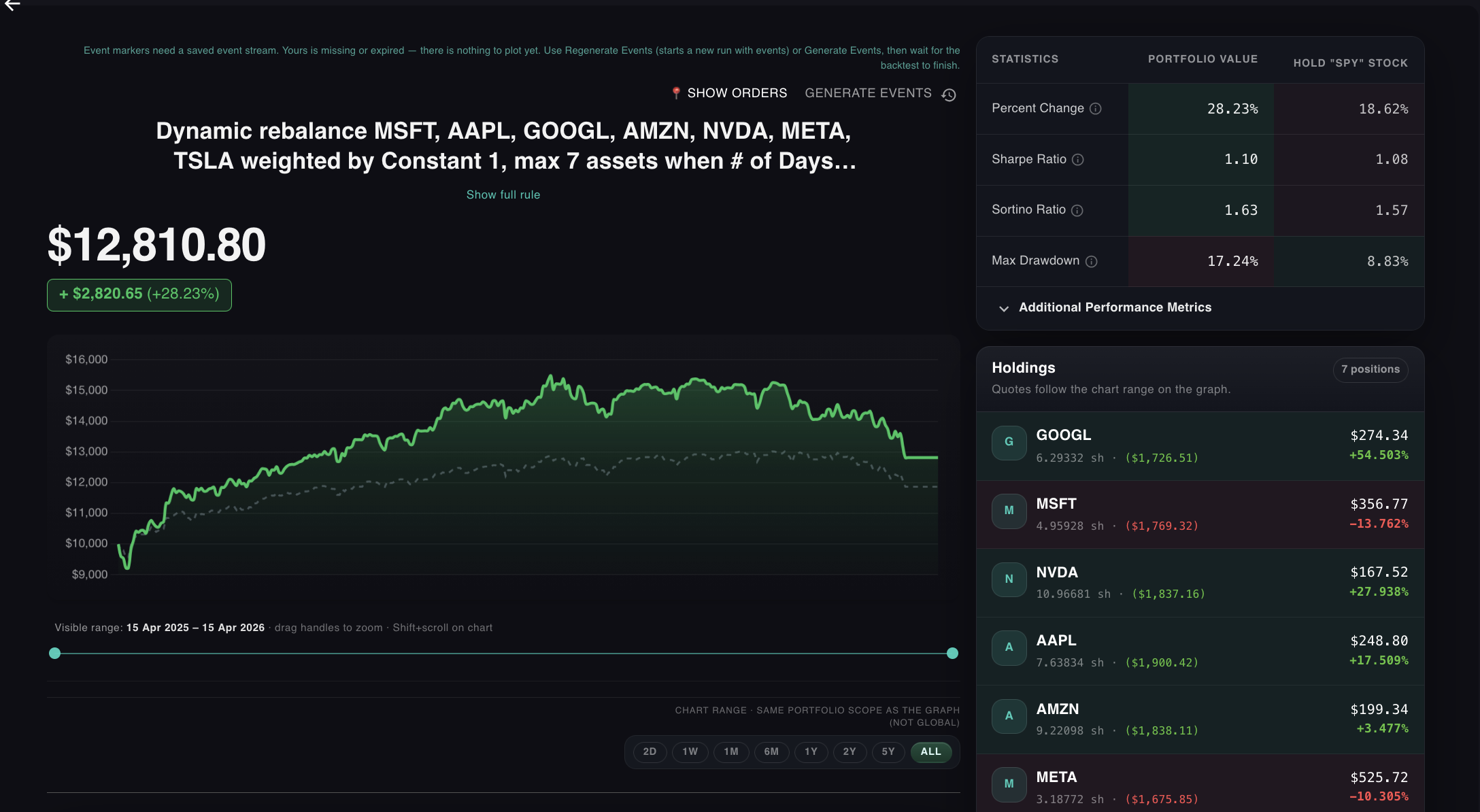
At this point, you know what your strategy is made of. You have indicators, conditions, and actions. You've backtested it honestly on data the optimizer never saw. You know its Sharpe ratio, its Sortino, its max drawdown, and exactly what kind of market conditions it was built for.
That's the difference between a strategy and a guess. Going live with a guess is how people lose money. Going live with a tested, understood, well-scoped strategy is how you trade with confidence.
Module 6 is about making that transition without rushing it. Paper trading first. Broker connection. Execution schedule. A pre-deployment checklist that forces you to answer the questions most traders skip. By the end, you'll know exactly when your strategy is ready to run with real money, and when it isn't.
NexusTrade's backtesting engine runs your strategy against years of historical data in seconds. Aurora can help you interpret the results and optimize your parameters.
Get 3 Months Premium Free — via Public.comOpen a Public.com brokerage account, connect it to NexusTrade, and get 3 months of Premium free. · Or take the full course →
No comments yet.