TL;DR
Published 2026-10-16. HeyGen Voice 1 Professional is the best AI voice model in this test: trained on 72m32s, approved on its 22.16s demo on 2026-10-14, and now the author's default voice.
- Published
- 2026-10-16
- Published model rows
- 2
- Evidence
- Historical task evaluation
Hear the demos the verdict is about
A voice evaluation you cannot hear is a spreadsheet, so both demos are on this page. The Professional demo is the evidence behind every verdict here: one 22.16-second render of the fixed script, checked and approved on 2026-10-14.
The Instant Clone needed no dedicated training, so it cost nothing to try — and it shows in the result: it was not adopted.
How the approved clone was built and checked
Train on 72m32s of real speech
Ten recordings went into the Professional Clone: seven course-speech stems (28m06s) and 367 original article-reading clips packaged into three WAVs (44m26s). No generated clone speech, tempo change or enhancement was introduced.
- Recordings
- 10 files · 72m32s total
- Course speech
- 28m06s across 7 stems
- Article readings
- 44m26s across 367 clips
- Model
- heygen-voice-1 · professional slot
HeyGen trains on the recordings as submitted. The professional add-on slot includes five pooled training runs per billing period, and failed trainings are free.
Render one demo at fixed settings
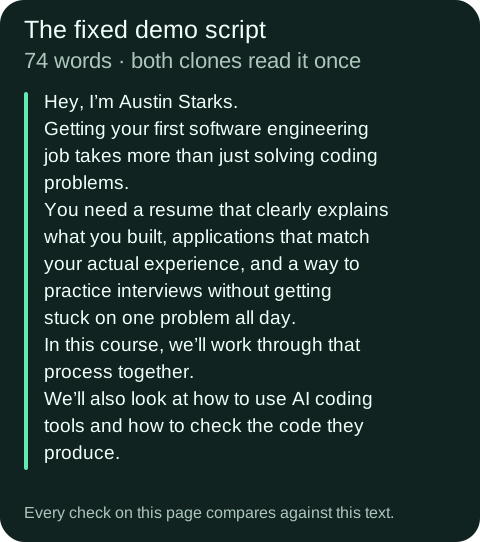
One 74-word script — the opening of Austin’s software-engineering course — rendered once at seed 3 into raw native audio, with the synthesis response saved before download so a re-fetch never re-renders or re-bills.
Listen to the approved demo- Duration
- 22.16 s
- Format
- 44.1 kHz mono PCM16
- Seed
- 3
- SHA-256
- 2ca3d3aaed254456…
22.16 seconds of 44.1 kHz mono PCM16, byte-hashed on arrival. The same settings, script and receipt accompany every future render.
Pass the machine checks
An OpenAI transcription of the rendered audio is compared word by word against the script, and the waveform is measured for clipping.
- Lexical error rate
- 0.0 — every word matched
- Peak level
- −0.01 dBFS
- Full-scale samples
- 0
The Professional demo matched every normalized script word (0.0 lexical error rate), peaked at −0.01 dBFS, and contained no full-scale samples. These checks prove word delivery and a clean signal — they do not establish naturalness or identity.
Pass the human gate
Austin heard the Professional demo on 2026-10-14 and gave his verdict out loud. No waveform or transcription can substitute for this step.
“this is great” — and the clone became the default voice for new narration. The verdict belongs to this 22-second demo: every new script still gets its own checked render.
Published results
Open every published row
Scroll sideways to compare all columns. Select a heading to sort.
| HeyGen Voice 1, Professional Clone | Professional; trained on 72m32s (28m06s course speech, 44m26s article readings) | 22.16s, 44.1kHz mono PCM16, seed 3 | "this is great" (2026-10-14) | Adopted: author's default voice |
| HeyGen Voice 1, Instant Clone | Instant; one 2m50s recording, no dedicated training | 25.26s, 44.1kHz mono PCM16 | No audible identity verdict recorded | Not adopted |
No matching rows. Clear the filter to see all records.
Two HeyGen Voice 1 voice clones created on 2026-10-14: a Professional Clone trained on 72m32s of speech and an Instant Clone from one 2m50s recording, each with one checked demo. Published 2026-10-16; values keep their original units and the verdict belongs to the demo on file. This table is not a new run.
What each check does and does not establish
Word match is not identity
The transcription gate proves the demo delivers every scripted word with a clean signal. It measures nothing about naturalness or similarity to Austin’s real voice — that is what the listening verdict is for.
One listener, one demo
The verdict is the author’s on the saved 22.16-second demo. It is not a blind ranking, and a clone that passes one script can still fail another, so each new script gets its own checked render.
August’s blind ranking stays separate
In August, sixteen arms of eleven systems read one 67-word script blind, and fine-tuned Dots.TTS soar won; HeyGen did not run that round. The two studies share one speaker, not one methodology — neither result replaces the other.
Cost, turnaround and scope
Open the receipts and limits
Trained the Professional Clone on ten recordings totaling 72m32s: seven course-speech stems plus 367 original article-reading clips packaged into three WAVs.
Created the Instant Clone from one 2m50s recording on the same heygen-voice-1 model.
Rendered one demo per clone and checked WAV format and duration. The Professional demo's OpenAI transcription matched every normalized script word.
The author heard the Professional demo on 2026-10-14, called it "this is great", and made it the default voice for new work.
One speaker, one voice. The August blind ranking on a fixed 67-word script named fine-tuned Dots.TTS first; HeyGen did not run that round.
One demo per clone. No audible identity verdict was recorded for the Instant demo, so its row records format and duration only.
The Professional verdict covers the approved 22.16-second demo. Each new script still gets its own checked render.
Cost
The Professional Voice Clone add-on costs $29/month at the checkout’s launch price, publicly announced at $99/month; the prorated first charge was $5.79 (receipt 2713-0132). The published API synthesis rate is $30 per million characters — about 1.3 cents for the 440-character demo script. No included synthesis allowance was documented with the add-on.
Turnaround
About 20 minutes passed between the creation request (19:33 UTC) and the ACTIVE voice with its rendered, verified demo (19:54 UTC) on 2026-10-14. No per-render synthesis timing was recorded.
No comments yet.